Time is an Editor
A review of Andrea Gibson’s 2021 “You Better Be Lightning” for Button Poetry

I’ve been editing the same books of poetry for years. My restaurant family memoir in poems, Snug Harbor, was the rock, the one they say “I needed to write”. Then there were the local legends, the empty factory histories, the ghost stories, the just for fun ones. The first poems I cut from the manuscript had no stakes or blood in them. But I loved them and now they have a sleepy file in my drive. My little histories and roadside-sign stories, gathering dust.
And then my work grew this other, sarcastic, worn, sneering voice. Whereas my first speakers inhabited restaurant family poems, this new voice had more politics, more pointed and direct commentary, more venom, more bitterness; it was a new voice focused on the present rather than growing up. The second book came from the first like a budding, or cell division, like the moon out of the breaking of the proto-earth on impact with some cosmic rock. Now I have two on the burner, and another simmering in the new notebook. I’ve got time.
But what if I didn’t? What if there was too much to say, what if I had you, dear reader, by the scruff and had to beam my story, my caution, my advice and solidarity and sex and elegy and yes, my love into your brain? What if I had one book to do it? What if time was short? What if I wanted to make it a call to action? What if I wanted to shock you to move? What if I wanted you to be hit by lightning?
Andrea Gibson’s 2021 “You Better Be Lightning” for Button Poetry is a 109 page testament. It’s a collection in the true sense of the word in that it has everything the poet had to say, had to make sure we heard—like ‘no really, look at me and listen.’ Look at the warmly imperative title: ‘You Better Be’.
I was left reminded that I have not much of and yet so much of the main resource fueling all of this urgency— time.
Andrea Gibson’s 2021 “You Better Be Lightning” - -Button Poetry
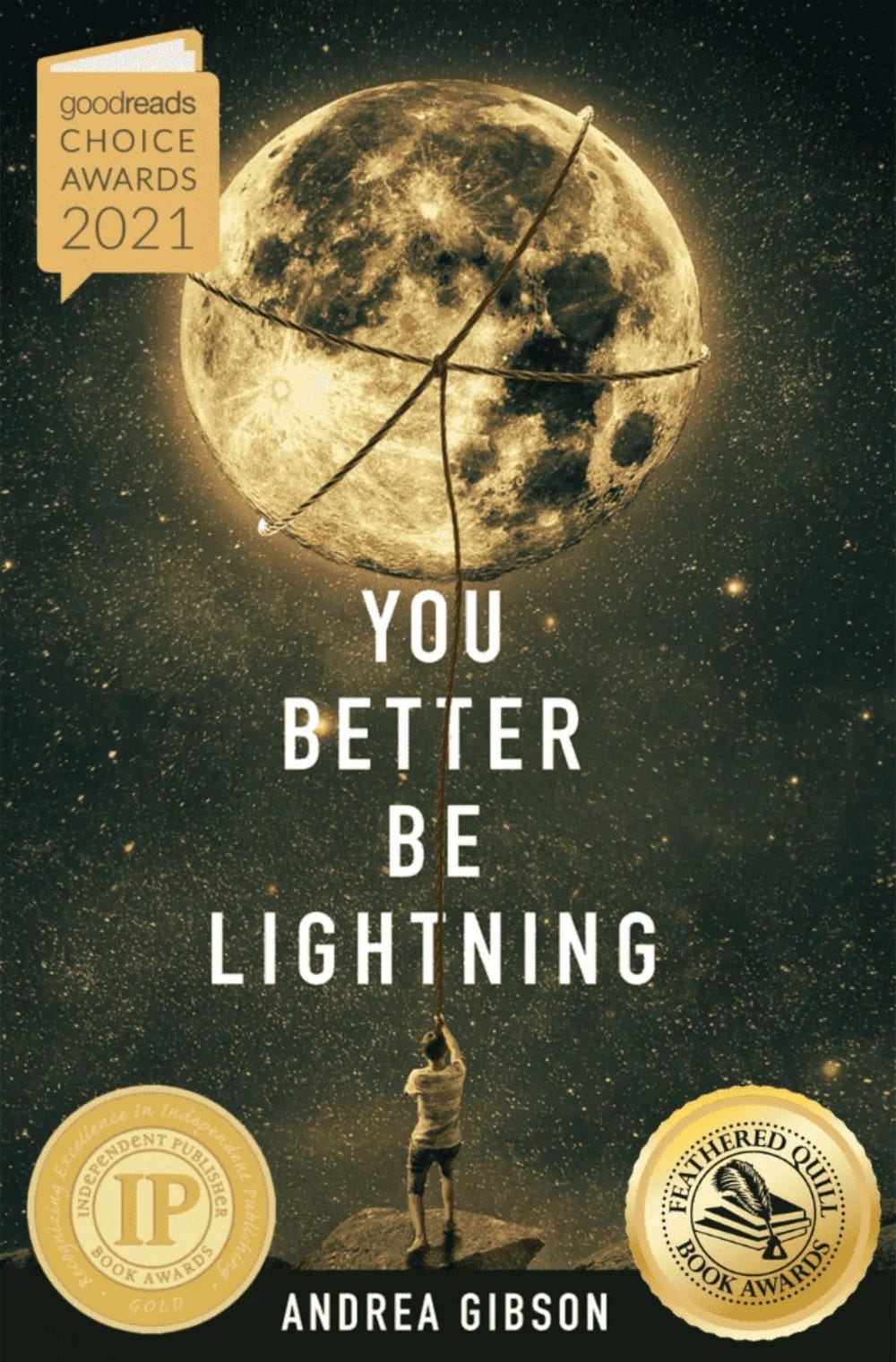
from Andrea Gibson.com
You Better Be Lightning by Andrea Gibson is a queer, political, and feminist collection guided by self-reflection.
The poems range from close examination of the deeply personal to the vastness of the world, exploring the expansiveness of the human experience from love to illness, from space to climate change, and so much more in between.
One of the most celebrated poets and performers of the last two decades, Andrea Gibson’s trademark honesty and vulnerability are on full display in You Better Be Lightning, welcoming and inviting readers to be just as they are.
Awards
2021 Goodreads Choice Awards – Finalist (Best Poetry Book)
2021 Bookshop’s Indie Press Highlights
2022 Independent Publisher Book Awards – Gold Medal Winner (Poetry)
2022 American Library Association Over The Rainbow – Shortlist
2023 Feathered Quill Book Awards – Poetry – Winner
A new way of seeing
To read this book is to wonder if Andrea needed an editor. If they could have had two books here, one ready and one that needed time.
Many poems hit me like a plea to not be so cool; to stop self-monitoring, to ‘kill that which cringes’. The opener “ACCEPTANCE SPEECH AFTER SETTING THE WORLD RECORD IN GOOSEBUMPS” is a narrative poem beginning with a memory of seeing Maya Angelou read and the curiosity about the effect of that reading, the aforementioned goosebumps, leads the speaker to measure their life by that measure:
“One day, my friend scored tickets
to a Prince concert. […]
421 (artists formerly known as) goosebumps.[…]
An enemy’s love poem: 232 goosebumps.
[...]
A split second when nothing in the world is dying?
888 goosebumps,”
I see this as the opening of a manifesto, an ars poetics, an ode to experience and looking, the speaker recounts a shift in their thinking from which they cannot return:
“There is no escaping the magic now.
Beauty caught me and never let me go.”
Here is a tool to see and perhaps the reason these poems began to feel catalogic from a poet slipping into some sort of clarity of joy in grief, some strange plane of acceptance and grace. This first poem wants us to learn to see.
Time is an ingredient
Again, I return to self implication in my own work. I have heartfelt poems I revisit and I repeat a mantra for writers, “Time is an ingredient.” The speaker of Gibson’s poems was protecting themselves. I wanted to use the poem to sort and control and even create distance between story and speaker. And when I return to revise, I see the poem within this context, with time I can see the veil. I can write a truer word.
Maybe I am reading into the context of the late poet’s journey with cancer, the multiple recurrences before their death in 2025 and the release of the documentary “Come See Me in the Good Light” directed by Ryan White, but I don’t think it would be unfair to think of this collection that way. Gibson wanted to say it all and they wanted to say it now, in earnest.
What I love about this Gibsonian directness is that I knew a poem like “Time Piece” was coming because this collection isn’t going to leave something unsaid, it doesn’t dance around. The poem reads:
“The Buddha says
the right time is always now.[...]
Time is money.
But the end of money
is wow.[...]
If we never deny
the inevitable end
of the story,
we will write it
more beautiful
while we’re alive.”
Often, I felt embarrassed by the earnestness of these poems. I think of myself as too involved as a writer in my own slyness or gesturing or syntax to just say “it”. This isn’t to say that Gibson’s poems are devoid of figurative language, but rather I had a sense that even in the most wrenching moments, the language served the deep necessity of the poem and often played, yes played, in the face of the reality of the speaker, in a way that felt untouchable to me, inappropriate even.
New sincerity
To some extent, as someone who had a wholly analogue childhood before a nearly completely digital adolescence and young adulthood, I can reflect here on my own partial irony poisoning. There’s friction in how I poured my heartbreak into my first poem in 7th grade vs how I thought about a love poem for my wife the year we got married. Of course, I’ve grown up, been in love a few times, but I also see the influence of a seemingly very online ironic humor have affected how I filter what makes it to the page. I can track, in my journals, a sea change from I-am-the-first-person-to-ever-be-in-love to a too cool to write a love poem, before landing, many poems later, in the company of a different kind of art, one that was a part of the early internet: a ‘new sincerity’.
I wanted to be okay getting caught caring about something unironically. I wanted to tap back into something I had in or before I’d learned a bad habit. I was tired of my comedic, ironic armor. And in the face of irony pilled online humor becoming hand in hand with the ways white nationalists move through online spaces, to be sincere became somewhat of a rebellion. As I saw more and more the self-monitoring awareness exhibited by an online Gen-Z, my desire to shed my irony grew and I began to imagine myself as someone who was fine with caring and trying hard out in the open. But it was only a recognition of a pattern, metacognition, and reflection, not the whole journey. Even accidentally, I noticed that I tended to cloak myself in distance and my own prescribed writing choices; the habits and internal ‘rules’ were still there. And I couldn’t write a love poem that I liked or felt as honest as anything Gibson employs.
Love is an x-quantity
So why must my love poems be so self-serious? Why do I connect serious topic with serious art? Why do I see the topic, paired with tone, as a binary: serious or sarcastic? Joking or earnest? There was a time when I was a baby poet when I backed myself into the logic that my poems, my thoughts were written and born whole, perfect, enlightened. I believed that poetry was only about that moment of being driven to the page out of necessity. To revise was to somehow undo that magic. But the best lessons of my own creative life were that discovering my craft and process is fun. It was fun to play with how I want to affect the reader or how I want to carve around the moment of composition or against the first idea or to splay the guts the first draft had to hide. If I was beholden to ‘first thought, best thought’, to the artist as inspired by muse, full stop, I think I’d miss out on what Corita Kent and John Cage called ‘x quantities’: the unexpected, the beautiful surprises of the process that can only emerge when I am flexible, playing and having fun.
Gibson bottles a first impulse, a strident declaration of politics and what their speaker sees as principle, and the poem becomes a door into how love is a complicated forever ‘x-quantity’ that, when lived or expressed, can often be unheralded. When the speaker chooses not to voice a political conviction to a crowd, they are privately acting on a deeper principle, responding to the surprise of love within themselves that has shaken and reordered their priorities.
The prose poem “WHAT LOVE IS” tells the story of a moment when the speaker made a choice to not call out fracking at a reading their partner’s father was attending because the father worked in the fracking industry. This speaker grapples with the choice and they read a love poem decidedly queer, but they do not make the political statement. After the reading, the fracking father bursts into the back room crying and embracing the poet saying:
“I’m seventy-six years old, he said, and I just tonight figured out what love is.”
I read this like the speaker’s bonafides. This speaker’s admittance that they aren’t necessarily speaking from enlightenment or a perfect nirvana, but rather from a truth we may not have access to— speaking from that ‘goosebumps’ induced way of seeing they cannot undo. The same poem ends:
“It’s just a moment in my life where I did something wrong, and the earth, who has never not known what love is, held me anyway.”
That is where the speaker ends in the earnest, desperate message.
To speak of about death…
And the experience piles up. These often stolid speakers are trying to do what they can for their niece, their love, their lover, themselves all with an eye on the moon. Gibson’s speakers are so matter of fact, so unadorned in their straight talk, so unbothered with euphemism that I am the one left with all the baggage and misgivings. I am the one closing one eye and asking to have the truth told to me slant or bundled in metaphor; it hurts. I feel a terror or an awe for the person so comfortable speaking about death.
The final poem “THE LAST HOURS” written in prose blocks blends speaker and poet in a way that elucidates my discomfort with being seen and being in the presence of someone so willfully trusting, uncynical, and unafraid to simply write what poets are always saying without saying it.
“I’ve written so many poems in my life. [...] Isn’t it amazing that I came up short? Isn’t it everything that I tried so hard and failed to write a single thing more beautiful than
love.”
This is a capstone poem that makes the collection, that snaps into focus what I’d initially read as cataloging or as too many threads. This is one of those poems that retroactively makes the book. I tell my students that ‘we don’t read to get to the middle’. Gibson’s last poem wants to say ‘Yeah it was all worth saying and worth living, but it doesn’t touch the simplest, one word missive. This is the only ending I care about.’
The Power
I’m not sure about this book. I’m caught up in the poet and their story both within the book and beyond it. I can’t help but read context into these and it feels like the directness invites that, welcomes that, wants to strip adornment from our relationship and get down to brass tacks. You Better Be Lightning is a life lived and looked back on without a dram of nostalgia. I think my own bias towards using nostalgia as a way to rescue my childhood, my working class values, my parents, my own story leaves me to resist these speakers in some way.
Reading this book was like being in a mind as it recalculated the past, all while appreciating an ever-narrowing future. There is celebration in a life lived, gratitude for accomplishments and flaws. These poems have a capacity for joy that scares me because I’m not sure I am brave enough to express this amount of grace without a veil of language. In my own work, I wonder about my fear. I am aware of my desire to be loved and told that it’s okay. I don’t want my nostalgia confirmed, but to entertain, write, and create, requires some inner motivation to be heard. I am not sure I’m ready, like Gibson, to give up the power I have acquired in becoming The Storyteller.
NOTE:
If you’d like to buy a copy of “You Better Be Lightning” please consider ordering directly from the publisher or use Indiebound to find your local bookstore and order a copy.
Find your local book shop with IndieBound
Order directly from Button Poetry
Link your local bookstore using Bookshop.org
**Thank you for reading this final entry (for now) in my poetry review series.
SEAN WILL RETURN with more audio poetry and new poems.
“Silence rides shotgun / wherever hate goes.”
One of the few 2020’s collections I find myself revisiting often — appreciate spending time with an alternate perspective on it.
This is the poetry book I recommend to people who don't read poetry but need something to uplift them. I'm creating poetry readers one heart at a time.