Become Undeniable
A Review of the 20th anniversary edition of Richard Siken's "Crush"

Writers are so good at recommending what they’re reading. The best, the friends, are great at recommending what they think I would like based on what they’ve seen in my work or what is new and exciting.
But teachers, mentors, their recommendations, in my experience, often come with a demand, an order—You must read this. As in…this is what you’re ready for, this is the voice you need to hear in order to grow, to progress, to maybe even feel seen. The implication is that The Writer Sean needs to read this, needs to work in congress with this other voice, needs to be challenged and break through.
During the glorious week of workshops and readings at the Juniper Institute, the importance of deep reading was a constant presence. It is one thing to tell myself that reading helps the writing and writing helps the reading, but it is another to have it grab both sides of your face and make you say it back. I know deep reading and generating are one hand washing the other, and at Juniper it was coupled with the comfort of being with writers, living as a writer where reading and writing were akin to air, everpresent as opposed to refuge. Tiana Clark, my workshop leader, offered gracious line-level feedback on my work as well as a list of readings she suggested and recommended, but one was set apart:
Tiana wrote, “Crush is required reading”.
And this was not the first time she’d communicated a similar sentiment. In workshop, “Sean, you must read Crush.” At lunch, “must must must read Crush.”
To call this a recommendation feels too off-hand; this felt like being invited into a secret joy without cynicism, this was about living, but it was also an assignment. I felt excited to see what could be so insistent, I felt I had no choice; Crush was what I needed.
Crush - 20th Anniversary Edition by Richard Siken
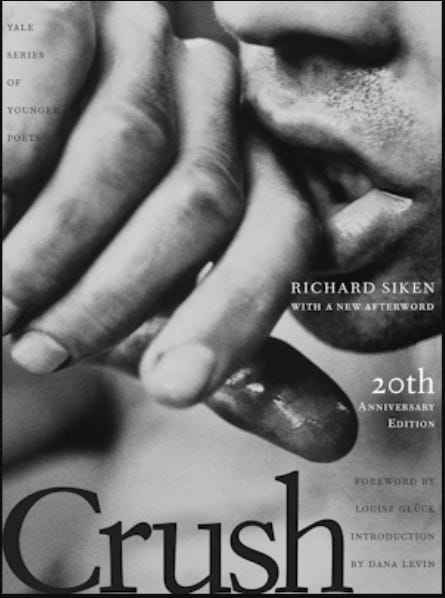
some reviews for CRUSH from Yale University Press
An Atlantic choice for “Best American Poetry of the 21st Century (So Far)”
“Crush liberated us by telling stories, by not swallowing what felt true. In symphonic sentences, it made suppressed emotions feel propulsive. It gave words to feelings--gorgeous words.”--Richie Hofmann, Yale Review
“The immense wingspan of influence that Crush has on 21st-century American poetry cannot be overstated. Not only does Siken center Queer yearning, he fills those poems with the detritus of life--the cacti, taco stands, twenty-four-hour supermarkets, interstates, boots and shag rugs--a project begun by William Carlos Williams, and here made palpable, enriched and enlarged to a whole new generation.”--Ocean Vuong, author of Time Is a Mother
Anniversary Edition
It’s strange to be arriving at a book that already has tails, and is a reissue this year. How does that happen? How does a poet get to that, even while living?
It was Dana Levin’s introduction that gave me, a new reader, the first indication of how a book of poems could have such an impact the day it arrives. Not to show that this was rare, but to retell the story of it coming to the surface
Dana Levin at the time, was a first reader for the Yale Series of Younger Poets contest. Levin made their recommendations and passed Crush, among others, onto Louise Glück. In what felt like insider baseball, she describes the process of selection for the Yale Young Poet’s contest as well as the first indication of what I was in for (and personally the first clue as to why this book was mandatory reading). She writes in their introduction, “Finally, after skimming many, I encountered a manuscript that felt blazingly alive.”
She felt it fit Glück’s requirements to only “send it on if it has a pulse.”
In her own Foreword to Crush, Glück highlights what to her is the soul, the “groundnote”:
“If panic is his groundnote, Siken’s obsessive focus is a tyrant, the body. His title, Crush, suggests as much. In the dictionary, among the word’s many meanings, “to press between opposing bodies so as to break or injure; to oppress; to break, pound or grind.” Or, as a noun, “extreme pressure.” Out of this cauldron of destruction, its informal meaning: infatuation, the sweet fixation of girl on boy. In Siken, boy on boy. In its fusion of the erotic and the life-threatening, the inescapable...”
Siken in his new Afterword for the 20th Anniversary edition is more concerned with the process that leads both to and from Glück’s vision. He focuses on the packaging, not the soul of it, but its presentation. His words are harsh and honest. He begins, “The manuscript was sloppy and I was afraid of it.”
Siken recalls that the phone call from Glück included, “[...]this manuscript is sloppy. It was not the best in the pile. I was reading manuscripts much better than yours, but while I was reading them I kept thinking about yours, so I knew it had to be the one.”
They had work to do. Later we get Siken’s point of view in the afterword, saying, “This manuscript was sloppy” before describing the process of arguing and fighting with Glück over her kitchen table about cuts and lines and images. And how through this forging and folding and shaping “left the manuscript’s ideas but cut its gestures” in other words, I hear that what remained were the true stakes.
And this, reader, is why CRUSH is mandatory reading: the stakes. The unadulterated necessity of the utterance, what Glück called panic, what Levin called blazingly alive, what I’ll read as a wish and example of what good editing can bring, what I want for my own work. The lesson of CRUSH is to become undeniable.
STAKES, BLOOD in the Mouth
On one level, maybe the easier level, the stakes were always there; the title brings violence to mind—to be crushed, to find the whole body inescapably trapped; but also that image of violence paired with the sense of having a crush, the sense of limerence and falling in love and how this is similar and calls to mind the oxymoronic, familiar language so-known-it’s-cliche and right on the shelf by love: lovesick, fatal attraction, unrequited love, pangs of love, love as conqueror, love is a battlefield, lovelorn, love lost, better to have loved and lost then to have never loved at all, falling in love, pierced by cupids arrow, and yes—crushed.
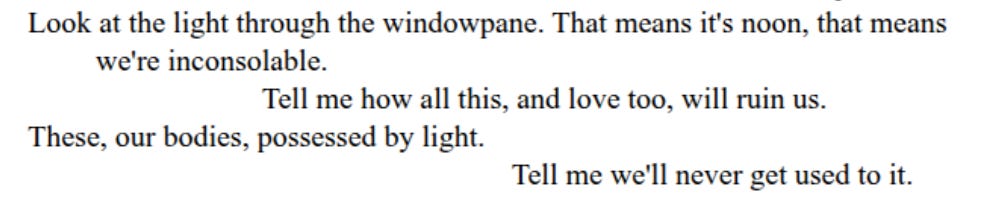
The opening poem “Scheherazade” slips into imperative. It commands me and others and the speaker in an inescapable way. The panic is true and uncomfortable.
“
”
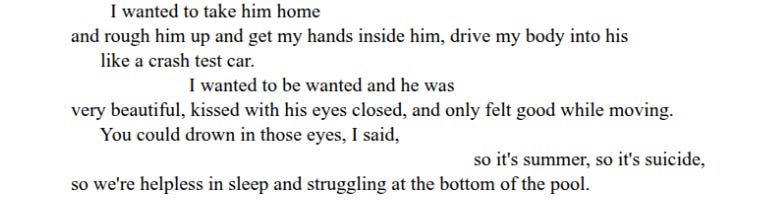
And later, Siken’s speaker shows us that they’re aware of what’s happening, aware of the tropes, but these are to be lived, exploded and inverted.
In “Little Beast” part 4:
“
”
Another easy level, that I feel is too cheap, would be to see this convenient dove-tailing of language and meaning as part of a confession or a part of confessional poetry that would have the reader as friend, confidant, close, secret keeper, lucky to find a diary that was meant for us, not interloper, but invited to hear, listen, attend.
To me, that’s too clean, too convenient, too familiar, or rather I’d say that’s the bait for the switch, the expectation for the surprise.
My own intent can spark a poem and perhaps becomes a burden. Many teachers, myself included, will talk in terms of what the poem “wants” but I rarely employ tactics to subvert that destination; I’m blinded or biased or feel loyal to the spark. Crush and the work to do more relief sculpture than pointing and gesturing is yet another lesson. The work matters, revision matters, cutting against what I think I want the poem to do can leave the core unadorned and impactful.
Should I Be Reading This? Should I Be Writing This?
If we add the Glückean panic, the voice, the body under the crush, all I hear is an undeniable cry, a refusal or an impossibility to remain silent. This book needed no reader and I am coming to it twenty years later after this book, as Siken unpacks in his Afterword, has gone through context change from inception to reception, and now belongs to a whole new set of readers with no knowledge of the Aids crisis or Reagan. Siken wrestles with this, but I think this realization lands as compliment and true surrender to the idea that this book was insistent. This book had to be.
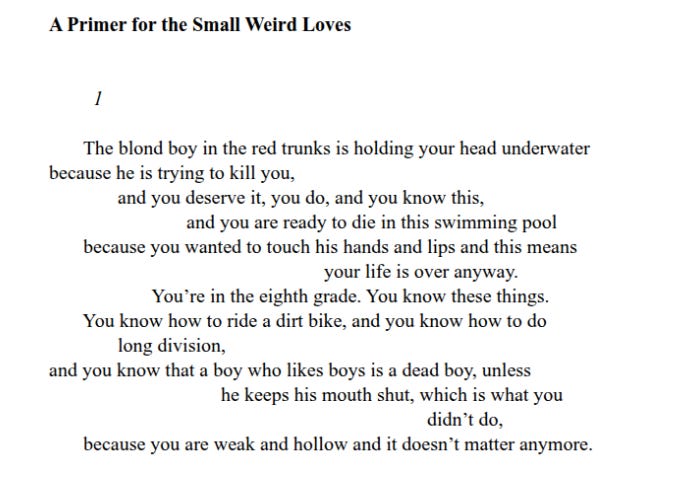
Levin saw it. Glück got stuck on it. More than confession, this was to be drawn into the gravity of intimacy and vulnerability. To not be able to look away. To read CRUSH is to be voyeur whether you like it or not.
“
”
Because I’m always noticing how each poet handles the reader’s understanding of positionality of the speaker to subject and reader through the function of pronouns as language, I was happy to see Siken discuss his intent with the mixing of the waters, the undefined way CRUSH swirls the I, the you, the we, the him, with names: Jeff, Henry, Jeff, and Jeff.
Not only are we trapped, but so are these speakers; the words, the utterance, the story, the image so undeniable that it erupts and disorients the reader and destroys itself even as it reaches the reader.
And, fuck, that makes me jealous and in awe and ready to learn. I want to be unfussy with my own work, to allow something to be delicate or precious but not in my own treatment, rather because that is the image or the memory or the sense; it was fleeting, it was tenuous and I want to capture it as so, not control or get too cute with my own desire or intent.
Later in “A Primer for the Small Weird Loves” part 7, the you is us and the speaker and the lover in a way that traps and unites, forces together and dares us to deny.
“
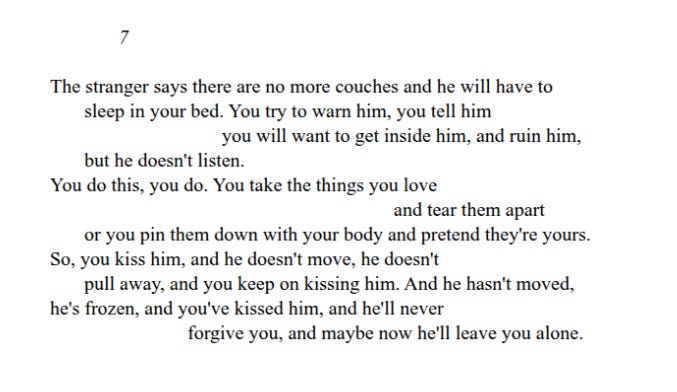
”
Catharsis
And yet I must say a word for hope. I must say a word for catharsis, for the Object existing. There is something healing, some release, something that this eruption was seeking, maybe undefined, but the poem “Saying Your Names” builds from the swirl of positions of speaker, reader, loves, subject, even author and lands in what must be the foundation of hope almost in an awareness or meta moment or fourth wall break because the truth cannot be contained. The poem ends:
Here is my hand, my heart,
my throat, my wrist. Here are the illuminated
cities at the center of me, and here is the center
of me, which is a lake, which is a well that we
can drink from, but I can’t go through with it.
I just don’t want to die anymore.
And finally, the last poem, the choice of where to end this book, where do floods of water or magma turned lava go, all that plasma, all that fluid...our speaker, and us, we may not know or it may defy the image.
The poem “Snow and Dirty Rain” ends:
We were in the gold room where everyone
finally gets what they want, so I said What do you
want, sweetheart? and you said Kiss me. Here I am
leaving you clues. I am singing now while Rome
burns. We are all just trying to be holy. My applejack,
my silent night, just mash your lips against me.
We are all going forward. None of us are going back.
The calm after the storm. Siken ends in the We and I feel the return or the coda or maybe the fermata or ellipses.
And then I return to Tiana and her “assignment”. In seventh grade, I got my heart broken, and I came to poetry wishing to be heard. That’s my origin story: sadboy. As I took on the mantle of poet, I wrote more of my family’s story and growing up in restaurants. And I wanted to tell that story as I experienced it, I was there afterall. And I think my work gets caught up in cleverness or slyness or the trap of sarcasm. My own story, when my poems focus on it, wants to play in a theater and perform, I want to consider how best to say it or how best to dress it up. I am processing my own parents and my own life by writing and through writing, but maybe I am muddying the waters, maybe I don’t trust the heart or the soul of the desire to write these poems that only I can write.
I think Tiana wanted me to see that I can be unadorned or sometimes I need to get out of the way and be raw and less assured. I think she wanted me to see that my poems need stakes and that it’s ok to hit the reader in the mouth with them. There’s a way that my craft could obscure the blaze or revise away the soul.
Crush is an invitation to admit to myself that the poem can just be and sometimes I can get out of the way. Because sometimes there is no other choice; we and it and us, we gotta go.

NOTE:
I realize this is not on an independent press, but this recommendation was the impetus for the entire project…and I had to include a classic.
If you’d like to buy a copy of “Crush” the 20th Anniversary Edition please use Indiebound to find your local bookstore and order a copy.
Find your local book shop with IndieBound
Order directly or link your local bookstore using Bookshop.org
love this! would love if you would submit some of your poetry to blankcanvaspost.substack.com if that’s something you’re interested in?